
Research & Publications
Welcome to my research hub, where I share studies and publications at the intersection of circular water and sanitation, smart water management, and process systems engineering. Each work reflects my commitment to developing evidence-based, practical, and scalable solutions for sustainable water futures.

WATER ENGINEERING

Strategizing Reclaimed Water Use in Metro Manila: A Hybrid Hierarchical DEMATEL–BWM Analysis of Adoption Barriers

Joshua Bon A. Roco, Michael Angelo B. Promentilla
Amid growing water scarcity in Metro Manila, Philippines, the country is exploring the use of wastewater treatment plant effluents as an alternative potable water source through reclaimed water use (RWU). However, no prior study has systematically mapped the causal interrelationships among multidimensional RWU adoption barriers in the Philippine context. Classical DEMATEL applied directly to complex systems imposes a substantial cognitive burden on respondents. This study developed implementation strategies for RWU using a hybrid decision-making framework that integrates the Hierarchical Decision-Making Trial and Evaluation Laboratory (h-DEMATEL) and the Best–Worst Method (BWM). The hybridization process involved weighting the prominence and relation values from h-DEMATEL with the relative importance scores derived from BWM. Findings reveal that effective communication with stakeholders and the public is the most critical intervention, as it addresses key perceptual barriers, namely, lack of awareness and the disgust factor. Equally important is ensuring the integrity of RWU systems to mitigate public health concerns. In contrast, governance and behavioral barriers were identified as low-impact and weakly connected within the system, suggesting they should be addressed in later phases of implementation. The hybrid h-DEMATEL–BWM approach proves to be a valuable strategic tool for guiding RWU adoption in Metro Manila. Future research may validate these findings through broader population surveys and explore additional context-specific barriers to enhance decision-making and policy design.


Urban Water Supply Planning and Management via an Integrated P-graph-Analytic Hierarchy Process Framework
Joshua Bon A. Roco, Vince Harvey O. Alano, Michael Angelo B. Promentilla
Water security is one of the pressing challenges in sustainable cities of the future as the demand for freshwater increases along with the environmental stresses caused by climate change. For example, Metro Manila, Philippines, experienced a water crisis brought by increasing demand and lasting impacts of climate change in 2019. In response, the Metropolitan Waterworks and Sewerage System (MWSS), together with its water concessionaires, Maynilad Water Services, Inc. (Maynilad), and Manila Water Company, Inc. (Manila Water), laid out a water infrastructure plan to bridge the water deficit. However, the decision-making process can be iterative and participatory characterized by uncertainty. This study thus proposed decision-making framework to explore the possibility of alternative sustainable water supply networks in Metro Manila through P-graph and analytic hierarchy process (AHP). Alternatives considered were saltwater desalination, rainwater harvesting, and non-revenue water (NRW) recovery. A sustainable network was defined as having low operational (OPEX) and capital expenses (CAPEX), high water security, and low global warming potential (GWP). Relative weights of sustainability, derived through AHP, showed that water security was the most important sustainability criterion among the surveyed experts in water supply construction and operations. P-graph simulations yielded optimal and near-optimal solutions indicating the possibility of not including the controversial water supply infrastructure project (Kaliwa dam) as a prioritized management option. Instead, sustainable supply networks relied on desalination, rainwater harvesting, and NRW recovery are identified as the main components of the optimal water supply network. Overall, the study suggests that better planning and accounting for sustainability is needed to identify and implement projects that do not only serve the short-term needs but also integrate well into the long-term plans.

Optimizing Viability of Urban Wastewater Management Strategies via P-graph
Joshua Bon A. Roco, Arnel B. Beltran
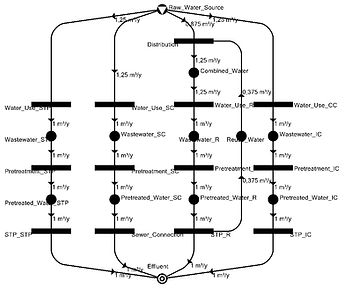
Around 80% of wastewater in Asia and the Pacific remains untreated and causes harm to bodies of water. Most low-income countries have difficulty improving wastewater treatment coverage due to the increasing cost of treatment, especially for the business sector. This study proposes a methodology for developing business wastewater management strategies by optimizing economic viability using P-graph for Metro Manila, Philippines. Four wastewater management strategies were considered: (1) to connect to a nearby domestic sewer, if possible, (2) to organize with other businesses and connect to a nearby sewage treatment plant (STP), and (3) to construct their own STP with and (4) without water reuse. P-graph simulations showed that businesses' most viable wastewater management strategy is to build a pre-treatment facility and connect to a nearby public sewer. Without a nearby sewer, businesses with non-domestic wastewater were recommended to connect to a nearby STP after pre-treatment. Only micro-businesses were recommended to connect to a nearby STP among businesses generating domestic sewage. The results of the study using P-graph recommended that small, medium, and large businesses generating domestic wastewater construct their STP ready for water reuse. Overall, P-graph has proven to be a valuable tool in urban-industrial wastewater management planning.

Aeration Phase Reduction in Sequencing Batch Reactors (SBR) through Optimization of Blower Operations via Response Surface Methodology

Joshua Bon A. Roco, John Erwin A. Uson
Method Validation of Moisture Analyzer as a Faster Alternative for Measurement of Total Suspended Solids (TSS) of Raw Septage for Polymer Dosing Feedback Control
Joshua Bon A. Roco, Frances Imee T. Valdez
Parametric Study of Factors Affecting Chlorine Demand via Multiple Linear Regressions and its Application on Feedforward Chlorine Dosing Control
Joshua Bon A. Roco, John Erwin A. Uson


PROCESS SYSTEMS ENGINEERING
Development of process systems engineering framework for water and wastewater planning in the Philippines

Joshua Bon A. Roco
This practicum report documents the co-development and pilot application of a Process Systems Engineering (PSE) framework for urban water and wastewater planning in the Philippines. Conducted within SMEC Philippines’ newly re-established Water Department (est. 2022), the practicum pursued two parallel goals: (i) professional growth through immersion in multidisciplinary consulting, and (ii) delivery of replicable decision-support tools that accelerate SDG 6-aligned infrastructure delivery. The methodology combined hierarchical DEMATEL to map causal drivers and barriers, the Best–Worst Method to derive optimal criteria weights, multi-criteria decision analysis and linear programming for technology selection, and QGIS-based spatial analysis for treatment-plant siting. Results identified climate change and infrastructure adequacy as essential factors in metropolitan supply planning, while net present value, land, and manpower requirements dominated treatment-plant decisions. Optimal sites clustered near urban centers, major roads and river corridors, minimizing conveyance and service-access costs. Tangible organizational gains include macro-enabled cost calculators, rapid-siting GIS templates, and a feasibility-study report shell that collectively trim project lead times by up to 33 %. Sector-wide, the project demonstrates how PSE can bridge fragmented Philippine water governance by enabling data-driven, cross-stakeholder planning tools that embed economic, environmental, and social criteria from inception. The practicum thus advances both academic competency and industry practice, positioning SMEC and its clients as leaders in climate-resilient, sustainable water management.

Philippine Energy Network Design via an Integrated P-graph and Analytic Hierarchy Process (AHP) Framework
Joshua Bon A. Roco, Michael Angelo B. Promentilla
Sustainable energy networks in the Philippines were designed through P-graph and analytic hierarchy process (AHP). Data used in the simulations came from Department of Energy’s Philippine Energy Plan 2018 – 2040 and OpenLCA software. Sustainability was defined as having low global warming potential, low capital expenditures, low electricity costs, high job generations, and high energy self-sufficiency. Relative weights were derived through AHP and integrated in the P-graph to calculate a sustainability score. AHP showed that energy self-sufficiency was the most important criteria among the surveyed experts. Integrated P-graph and AHP simulations showed that optimal and near-optimal solutions relied on geothermal and hydroelectric energy for electricity use while maintaining other energy sources such as coal, oil, natural gas, and biomass for non-electricity demands. Simulations also revealed limitations of P-graph in energy planning such as its inability to alter pre-set rankings in the energy mix and to scale up the model to simulate future years. The optimum energy network resulted to 52% lower global warming potential, 2% higher jobs generated, 27% lower electricity cost, 87% lower capital expenditures and 78% higher energy self-sufficiency than the current scenario.

Optimization of Urban Plastic Recycling Networks with Industrial Symbiosis
Joshua Bon A. Roco
Plastic recycling networks were reframed as eco-industrial parks that are capable of industrial symbiosis. A linear model was developed to transform an existing municipal solid waste management in Davao City, Philippines into an industrial symbiosis-enabled plastic recycling network. The network was participated by businesses, residences, municipal and city collection, and the informal waste sector. The reliability of the networks was measured using symbiotic profits, defined as the sum of all circulating materials minus the plastics going into landfill. Optimization was done to maximize symbiotic profit via linear programming. Two cases were considered, one was to optimize the existing city solid waste network and the other was the industrial symbiosis-enabled equivalent. Both simulations showed that landfill diversion was still possible by up to 23.0% and 27.2% higher than the existing or 14.7 and 25.4 tons per day diversion. The industrial symbiosis – enabled network has a symbiotic profit of 48.1% higher than the existing network. The informal waste sector contributed significantly to diverting wastes, increasing symbiotic profit, and strengthening the participation of businesses and residences in recycling networks. Sensitivity analysis showed that the informal waste sector directly increases the network’s symbiotic profit up to a point of complete symbiosis. Simulations have shown that industrial symbiosis can be an important tool to reduce solid waste in landfills. The study suggests that solid waste management network modeling must always include the informal waste sector due to their significant contributions to the success of the network. Future studies can expand into consideration of the full industrial symbiosis network, additional limiting factors and number of participants.



Developing Eco-schools in the Philippines through Resource Efficiency, Cleaner Production, and Circular Economy Principles
Joshua Bon Roco, Nicole Angelo Baes, Clair Angelie Hilacan, and Judy Ann Garcia
Non-government organizations (NGOs) play a critical role in attaining the Sustainable Development Goals, including microfinancing, capacity-building, and self-reliance. The Philippine Institute of Chemical Engineers – CAMANAVA Chapter (PIChE – CAMANAVA), an NGO situated north of Metro Manila, Philippines, has engaged in a sustainable community development with the public schools in Caloocan and Valenzuela City. PIChE – CAMANAVA developed eco-school programs using the principles of resource efficiency and cleaner production, and circular economy (RECP & CE). Priority system boundaries identified by PIChE – CAMANAVA and schools include paper, food, water, and energy. Programs are being executed through the circular design method; their ease of implementation ranged from quick-win solutions to those requiring a payback period of at least two years. Overall, the RECP & CE derived eco-school programs can generate savings that can support 345 student scholars annually. Moving forward, PIChE CAMANAVA aims to upscale the RECP & CE programs to develop eco-schools through the development of an eco-school manual, where public schools in the Philippines can quickly adopt programs applicable in their systems.


Optimization of Silver Recovery from Used Radiograph Films (URF) via Sodium Hydroxide Stripping
Joshua Bon A. Roco, Michael Vincent O. Laurio, Catalino G. Alfafara, Veronica P. Migo
The optimum conditions for the recovery of silver from used radiographic (X-ray) films (URF) by sodium hydroxide stripping was attempted using response surface methodology (RSM). From atomic absorption spectroscopy (AAS) and X-ray fluorescence (XRF) analyses, the URF had a silver purity of about 30.91% and a recoverable silver of 0.5845g Ag per 100g URF. Initial 2k factorial experiments showed that NaOH concentration, reaction temperature and contact time were significant factors at 5% significance level. RSM-designed experiments confirmed the significance of these factors, and a quadratic model was obtained to relate the factors to the responses (silver recovery and silver purity). Numerical optimization on the model to maximize both silver recovery and purity yielded an optimum solution of 90oC temperature, 1.75M NaOH concentration and 194 seconds contact time. Experimental verification showed 69.69% silver recovery with a reasonable difference of 12.62% from the predicted value. At optimum conditions, preliminary cost analysis showed that the recovery process costs ₱54.72, with profit of ₱39.26 per kilogram of film processed.

